
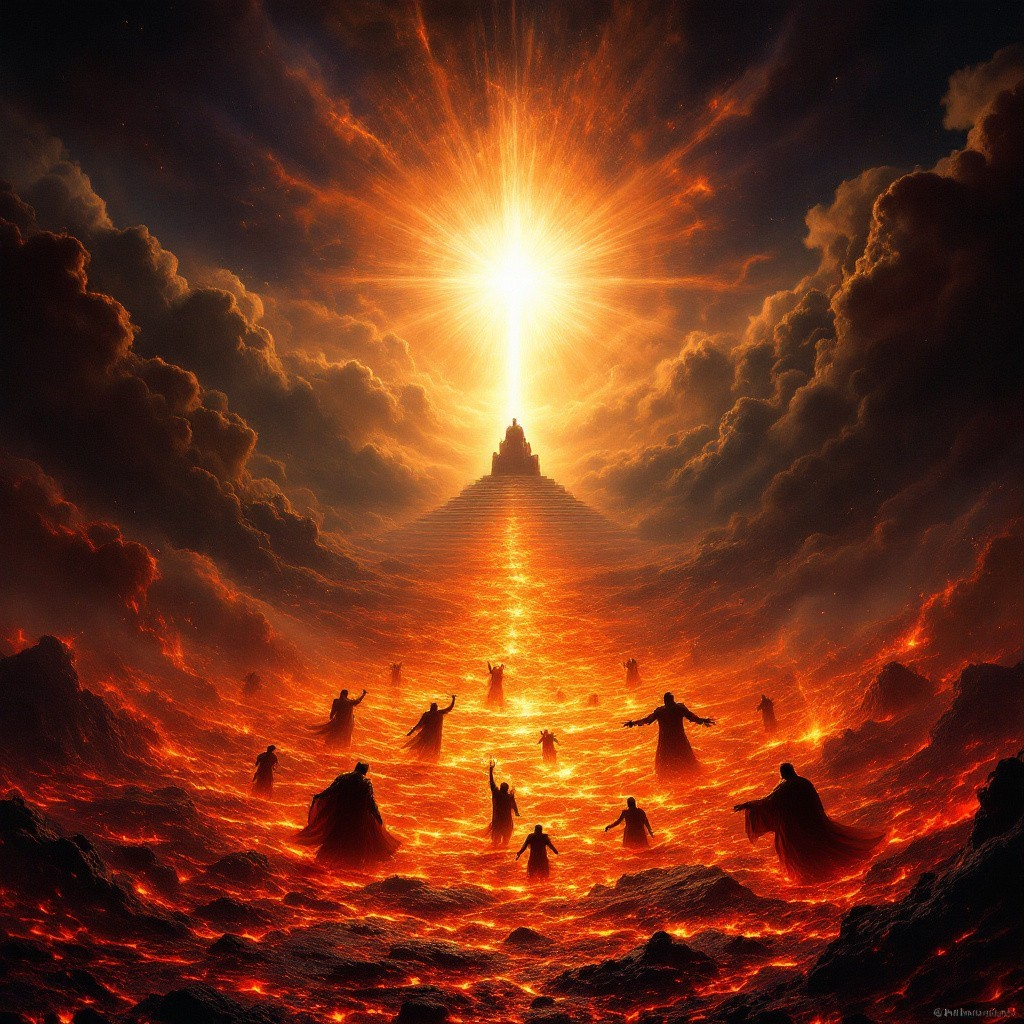
Fig. 1.2 A dramatic artistic rendering of apocalyptic judgment, depicting robed figures approaching a radiant pillar of light rising above a volcanic landscape. The molten ground, towering structure, and encircling darkness evoke themes of divine reckoning, spiritual ascent, and the perilous divide between salvation and destruction.
Christianity (Book of Revelation; widely accepted in traditional Christian eschatology)
Among the many images of divine judgment found in the Christian Bible, few are as striking or as final as the Lake of Fire described in the Book of Revelation. Unlike earlier biblical references to Sheol, Hades, or Gehenna, the Lake of Fire is portrayed as the ultimate destination where evil is forever defeated and removed from God's renewed creation. It appears at the climax of the biblical narrative, following the final judgment, and represents the culmination of God's justice over sin, death, and rebellion. Throughout Christian history, this vision has become one of the most recognizable symbols of eternal judgment and the ultimate fate awaiting those who reject God. The principal descriptions of the Lake of Fire are found in Revelation chapters 19, 20, and 21. After the final conflict between good and evil, the Beast and the False Prophet are cast alive into the burning lake of fire and sulfur. Following Satan's last rebellion against God, he too is thrown into the same place, where Revelation declares he will be tormented "day and night forever and ever." The vision then reaches its climax at the Great White Throne Judgment, where every person stands before God. Those whose names are not written in the Book of Life are cast into the Lake of Fire, an event Revelation describes as "the second death." Even Death and Hades themselves are thrown into the fiery lake, symbolizing the complete abolition of death and the final victory of God's kingdom. For many Christians, the Lake of Fire represents the ultimate expression of divine justice. It signifies the permanent separation of evil from God's presence and the establishment of a new heaven and a new earth free from sin and suffering. Traditional interpretations understand the Lake of Fire as a literal place of eternal conscious punishment, while other Christian traditions view it symbolically, representing irreversible destruction, exclusion from God's kingdom, or complete spiritual separation. Regardless of interpretation, the Lake of Fire stands as one of Scripture's most solemn warnings concerning the consequences of rejecting God's grace. Throughout the centuries, this powerful image has profoundly influenced Christian theology, preaching, literature, music, and sacred art. Medieval painters depicted it as a vast inferno consuming the wicked, while countless sermons used its imagery to emphasize repentance and moral accountability. The Lake of Fire has also inspired writers, poets, and filmmakers, becoming one of the defining symbols of divine judgment in Western culture. Whether understood literally or metaphorically, it remains the Bible's final and most dramatic vision of the defeat of evil, reminding believers that justice, according to Christian teaching, ultimately belongs to God alone.
The concept of the Lake of Fire is unique to the apocalyptic vision of the Book of Revelation. Early Christian theologians interpreted it as the culmination of God's final judgment, often associating it with earlier biblical images of Gehenna and eternal fire. During the medieval period, the Lake of Fire became central to Christian depictions of hell in art, theology, and preaching. It has remained a foundational element of traditional Christian eschatology, although modern interpretations differ regarding whether its fire should be understood literally, symbolically, or as representing the complete destruction of evil.
The image of the Lake of Fire has profoundly shaped Christian preaching, sacred art, literature, and popular culture for nearly two thousand years. It became one of the defining symbols of the biblical apocalypse, inspiring medieval manuscripts, Renaissance paintings, revival sermons, novels, films, and musical works. Its imagery continues to influence modern depictions of divine judgment and the end of the world, making it one of the most enduring and recognizable visions in Christian theology.
AI‑Assisted Content Notice:
Portions of this entry were drafted with assistance from ChatGPT (OpenAI, 2026)
and subsequently edited for accuracy, clarity, and theological consistency.